

bring back self-expression
the rapid homogenization of society and why we need to bring back our whimsy

Take a walk down the street. I’ll bet you a pretty penny and my flashy mood ring that you’d come across someone holding a Starbucks cup. Perhaps they’re even in a Lululemon Define jacket. Holding a riveting conversation with a friend on their brand new iPhone 17 Pro Max, aptly fitted snugly in a Rhode lip case. Let’s call this person Sam.
Sam, like the rest of the globe's 5.79 billion members, uses social media1. They grew up bushy-tailed and starry-eyed as a wild child of the 2000s, in an era of rapid globalization and the spread of international media and consumer culture. Sam’s dream is to become a rock star. Sam is an amorist, a poet with a flair for the enigmatic and archaic. Sam doesn’t fit in, and never has. By the time they reach college, they’ve learned the hard way that being too much doesn’t fly by society’s standards. Maybe, Sam thinks, they should tone it down.
Social media has become an integral part of Sam’s decision-making process—the latest fads are instructions on what to buy, and the newest trends are announced with a headmaster’s rigor on how to best do one’s makeup, dress, and act. At a time when Sam’s brain is most impressionable, during its formative years, when neuroplasticity is at an all-time high, Sam can’t help but absorb these trends with diaphonous helplessness.
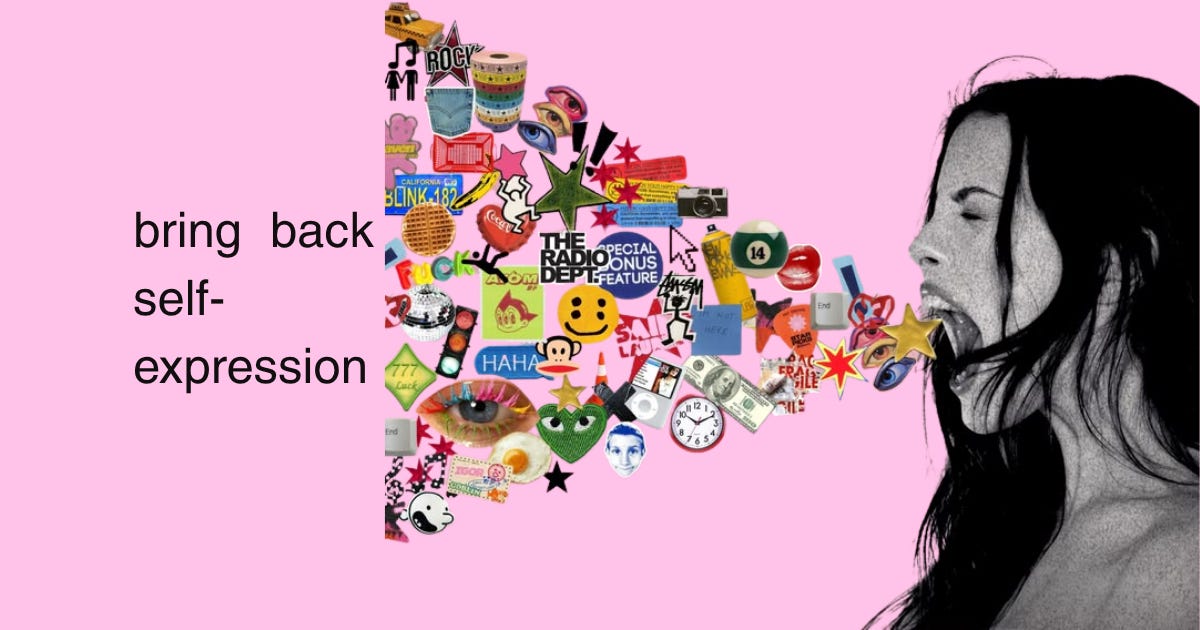
But this isn’t Sam’s fault. And it’s not yours, either. With the fastidious homogenization of cultures, language, traditions, food, fashion, and entertainment, our individual distinctions, which used to be wide asunder as polar regions, have now become a sort of amorphous greige blur; you can’t tell where it begins and where it ends. From 3,501 Starbucks stores in 2000, we now have over 41,100 globally in April of 2026.2 Trends like pink drinks and molten sugary coffees have taken over TikTok, and that’s just one of many examples.
The more we blindly and fatuously follow the trends we see online, the more we lose our self-identities in the process. We pinch and pull at our faces and love handles while staring at the (seemingly) perfect Barbie and Ken dolls on our screens, pleading to the universe, What do I have to do to be more like that3?
As a Gen Z, I can’t help but feel the pressure to conform to such heteronormative beauty and societal standards like a stranger’s hand pressed firmly on my lower back. I squirm awkwardly, a little uncomfortable, before finally wrenching it off me. I’m a 21-year-old growing up in modern society, and the one empowering thing I find I can do to push back against the system is to be authentically me, with all the weirdness that comes with it. True self-expression is undoubtedly going to go against the grain, and I know of the backlash that will come with it, but the one thing I cannot accept is not being truly me.
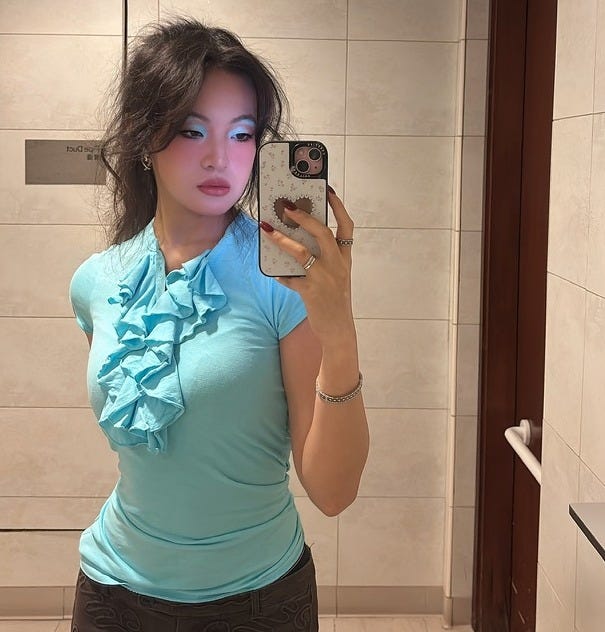
That is why, when my mother says I’m too much, that my makeup scares people, or my loquaciousness is off-putting, I no longer bristle and even try to hold an open conversation with her. Discovering colourful makeup and crazy outfits was like kismet, a feeling reverberating so deep inside my bones that I just knew it was right. My outside appearance finally matched the way I felt inside, a motley of neons and pastels, blushed and blended and glossed. If someone isn’t able to accept me for the way I am, I know that I would be better off without them in my life anyway!
Love,
Sennett
Creating and sharing my writing for free is important to me, but it does take time. If you enjoyed this post, I’d be honored if you considered buying me a coffee! It would mean the world to me xx
DataReportal, April 2026
Martinac Dorčić, T., Smojver-Ažić, S., Božić, I., & Malkoč, I. (2023). Effects of social media social comparisons and identity processes on body image satisfaction in late adolescence. Europe’s Journal of Psychology, 19(2), 220–231. https://doi.org/10.5964/ejop.9885
I think one of the saddest parts of modern culture is that people are encouraged to “be themselves” only as long as it’s still socially legible and aesthetically familiar. Its really, in my opinion, a big contradiction that continues to make you feel insecure.
Ugh “loquaciousness” is a great word and so gay-coded. And I love that cyan top, I don’t care what people think about it and I’m glad you don’t either.
The way you use colours on your eye makeup as well is probably one of the very few reasons I still go to the feed to see if you’ve dropped a banger.